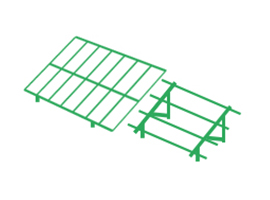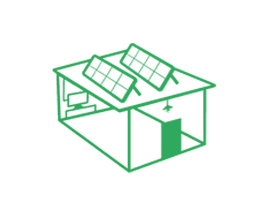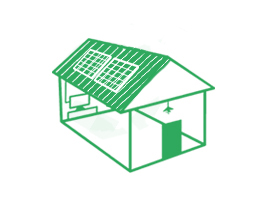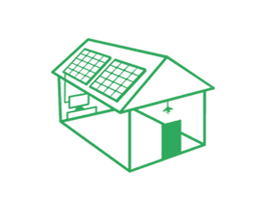
Wind load is the dominant governing load in the structural design of solar ground mount. It directly determines the section specification of profiles, foundation type, ballast weight and fastener selection. The content below illustrates the force mechanism and relevant design considerations:
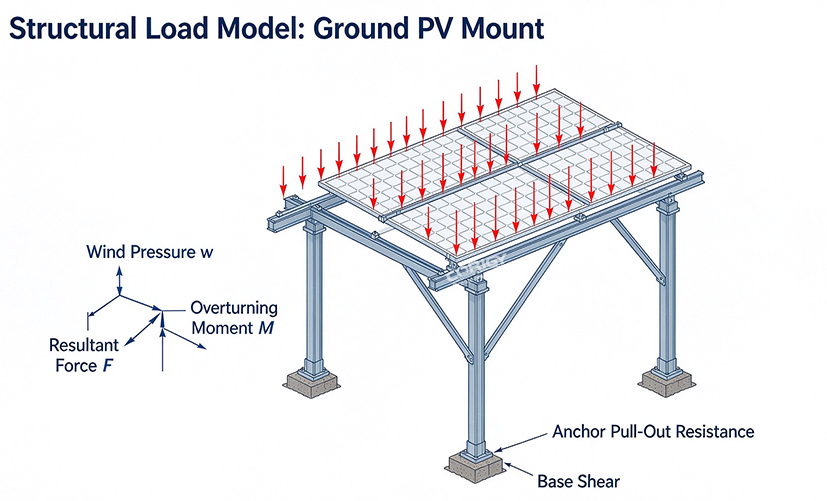
1. Action Modes of Wind Load
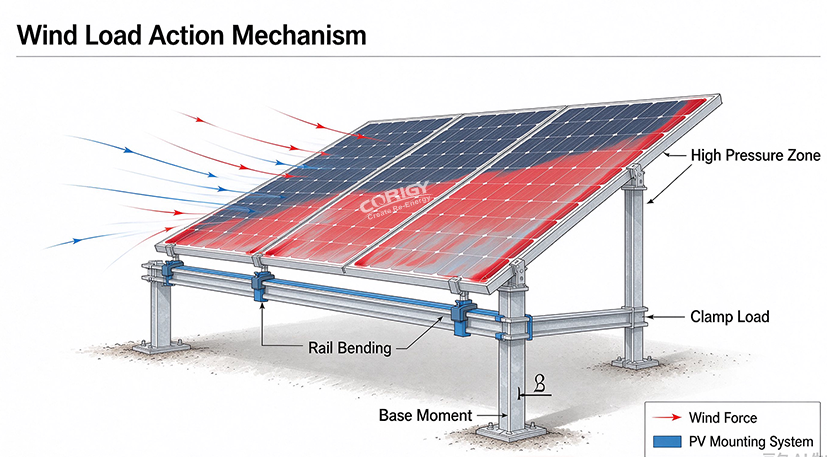
When wind flows over inclined solar panel bracket, three types of forces are generated:
Uplift: Negative pressure forms as wind passes over the top surface of modules, lifting the modules and supports upward. It is the most frequent cause of failure, including anchor pull-out, ballast overturning and whole-system blow-off.
Lateral Wind Force: Positive pressure on the windward side pushes the modules horizontally, inducing bending at the base of posts. Potential failures include rail connection breakage and foundation sliding.
In-plane Pressure / Suction: Wind pressure distributes unevenly across the module surface, with peak values at edges and corners. This may lead to PV glass breakage and clamp / end clamp detachment.
2. Specific Impacts of Wind Load on Components
2.1 Post / Pile Foundation
A. Lateral wind force creates maximum bending moment at the base of posts. Taller posts (e.g., tracker posts ≥1.5 m) generate larger base bending moment, which usually governs the wall thickness selection.
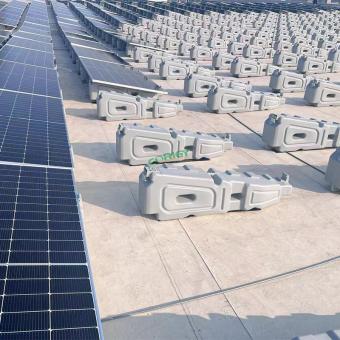
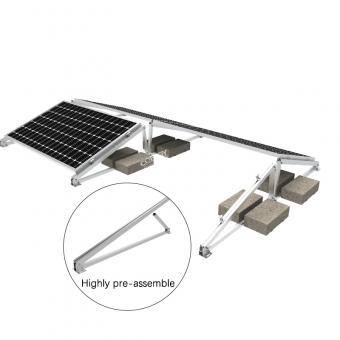
B. Uplift force acts directly on foundation anchors: ground piles shall resist pull-out force; for ballast type solar structure, the weight of ballast blocks must be verified to resist overturning.
2.2 Purlin / Rail
A. Wind load distributes along the module width; purlins and rails shall be checked for bending strength and deflection.
B. Wind pressure at edge and corner zones can reach 1.5 ~ 2 times that of the inner array area. Therefore, purlin spacing and clamp spacing shall be reduced for edge and corner zones instead of adopting a uniform layout for the whole array.
2.3 Module Clamp / End Clamp
A. Cyclic wind vibration may loosen fasteners — wind is not a static one-time load but millions of cyclic alternating loads.
B. Resonance will occur if the natural frequency coincides with the vortex shedding frequency of wind, which greatly increases the risk of fatigue failure. Reference: ASCE Library.
2.4 Additional Effects for rooftop mounting structure Installations
A. On flat roofs, vortex flow in edge / corner zones creates extreme negative pressure, where the wind load is the highest across the roof.
B. Parapet height, roof slope and module elevation will alter the wind field, so zone-based calculation is required.
Install solar panel on the metal roof by standing seam, klip-lok, L foot or other clamps.

태양 CORIGY , 11 년 동안의 경험을 연구,제조 및 판매 태양광 장착 시스템입니다. 우리는 항상 노력하고 최고의 제공에 대한 지원을 포함하여,빠른 응답,비용,QC,디자인,대리점을 지원합니다.
메일 주소
sales@corigy.com전화
0086-592-6883200위치
No.893,Haicang Avenue,Haicang District,Xiamen City,China.

 IPv6 지원 네트워크
 한국의
 English
 español